

Peripheral Inserted Central Catheter (PICC) placement is a critical procedure widely used in both acute and long-term patient care. It provides reliable venous access for medications, nutrition, and other treatments. Despite its common use, PICC line insertion carries potential risks, including infection, improper catheter placement, and patient discomfort, making proper training essential for healthcare professionals.
Simulation-based education offers a safe, effective method for learning and practicing PICC insertion techniques before performing them in real clinical settings. Through realistic task trainers, learners can develop the necessary skills and confidence while minimising risk to actual patients.
Why PICC Line Training Matters

PICC lines play a key role in patient care, particularly for those requiring long-term intravenous therapy. Incorrect placement or technique can lead to serious complications such as thrombosis, catheter malposition, or infection. For this reason, nursing staff, medical trainees, and interventional specialists must acquire both technical accuracy and procedural confidence.
While theoretical instruction is important, hands-on practice is irreplaceable in mastering the nuances of catheter insertion, guidewire handling, and patient positioning. Simulation tools provide that hands-on experience in a controlled, repeatable environment, ensuring that learners gain both competence and readiness.
The Advantages of Healthcare Simulation for PICC Training
Healthcare simulation offers several clear benefits over traditional apprenticeship-style learning. First, it allows repeated practice without time constraints or risk to real patients. Learners can focus on developing fine motor skills, ultrasound guidance techniques, and troubleshooting strategies in a low-pressure setting.
Additionally, simulation promotes active learning. It helps trainees internalise critical steps such as vein identification, insertion site preparation, guidewire advancement, and catheter securement. By practicing these components together, healthcare providers improve both speed and precision, essential qualities in real-world clinical environments.
Realistic Anatomy & Procedure Replication

Effective PICC training requires task trainers that accurately replicate human anatomy and procedural conditions. High-quality simulators incorporate anatomically correct structures such as veins, skin layers, and responsive tissue feedback.
Features like real-feel vessel resistance, ultrasound-compatible materials, and fluid flow systems enhance realism. These elements allow trainees to experience challenges similar to those encountered with actual patients, from navigating complex venous pathways to managing blood flashback during catheter placement.
Meeting Clinical Competency Standards
Simulation-based PICC training aligns with competency-based education models in nursing and medical programs. Many institutions and hospitals now require healthcare providers to demonstrate proficiency on simulators before moving on to patient care.
By integrating simulation into regular training and certification pathways, organisations help ensure staff meet safety and quality benchmarks. This proactive approach supports better patient outcomes while reducing the likelihood of adverse events linked to procedural errors.
Introducing Simulab’s PICCLineMan System
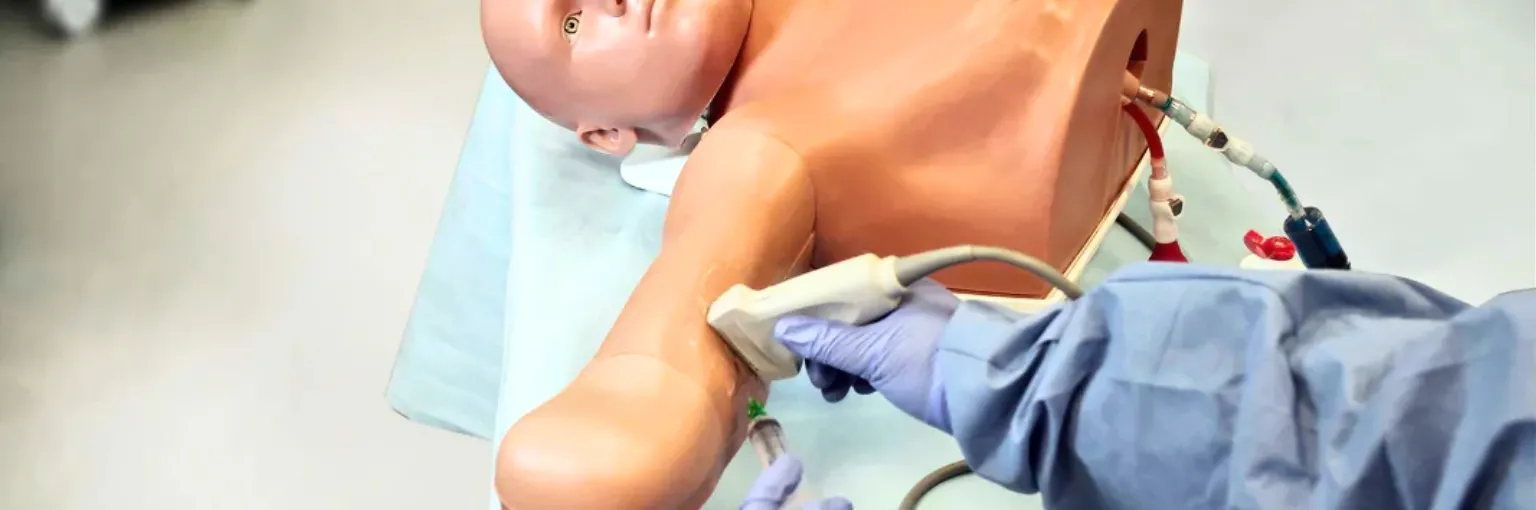
For healthcare educators seeking a comprehensive PICC training solution, the Simulab PICCLineMan System offers a proven platform. Designed for realism and durability, PICCLineMan allows medical professionals to practice the complete PICC line insertion procedure using real-time ultrasound guidance.
The system replicates every step of the process, including needle insertion, guidewire placement, dilation, and full catheter threading. Features such as self-healing tissue layers and ultrasound compatibility make it suitable for repeated use in clinical skills labs and simulation centers.
By providing consistent, high-quality practice opportunities, Simulab’s PICCLineMan System helps healthcare teams build the confidence and competence necessary for safe and effective patient care.
To learn more about Simulab’s PICCLineMan, visit our page now: https://bmec.asia/my/simulab
More Information
Simulab Corporation | https://simulab.com/products/picclineman-system
Reference:
- (n.d.). PICCLineMan System. Retrieved from https://simulab.com/products/picclineman-system
- Infusion Nurses Society. (2021). Infusion therapy standards of practice. Journal of Infusion Nursing, 44(1S), S1–S224. https://www.ins1.org/
- Oermann, M. H., & Gaberson, K. B. (2021). Evaluation and testing in nursing education (6th ed.). Springer Publishing.
Simulab Corporation / BMEC Pte Ltd