

Healthcare education faces increasing pressure to train larger numbers of learners while maintaining high standards of competency and patient safety. Traditional clinical training methods often rely heavily on instructor availability, physical equipment, and access to clinical placements, which can limit training capacity and consistency. As healthcare systems continue to evolve, educational institutions are looking for more flexible and scalable approaches that can support learners across different disciplines and experience levels.
Virtual reality (VR) has emerged as a powerful solution to these challenges. By creating immersive and repeatable learning environments, VR enables learners to practise clinical skills safely without depending solely on real patient interactions. This allows institutions to expand training opportunities while ensuring that learners can build confidence and competence through repeated practice.
Immersive Learning & Realistic Clinical Scenarios

One of the greatest strengths of VR-based clinical training is its ability to simulate realistic healthcare scenarios. Learners can interact with virtual patients, perform procedures, and make clinical decisions within a controlled environment that mirrors real-world practice. These immersive experiences help strengthen critical thinking, decision-making, and procedural skills while reducing the risks associated with practising on actual patients.
Because VR simulations can recreate a wide range of clinical situations, learners are exposed to experiences that may not always be available during traditional placements. From emergency response scenarios to routine patient care procedures, VR training allows repeated exposure to important clinical cases, helping learners improve retention, accuracy and confidence.
Standardised, Flexible & Data-Driven Training
Another key advantage of VR training is the ability to deliver standardised learning experiences across multiple users and locations. Every learner can undergo the same scenarios, assessments, and procedural steps, ensuring consistency in training quality and competency evaluation. This is particularly valuable for institutions managing large student cohorts or multi-site training programs.
VR systems also provide flexibility in how and when training is conducted. Learners can train independently, revisit scenarios multiple times, and progress at their own pace. At the same time, built-in analytics and performance tracking allow educators to monitor progress, identify learning gaps, and provide targeted feedback. This data-driven approach supports continuous improvement and more efficient skills development.
Advancing Clinical Education with Simlogic SkillupVR
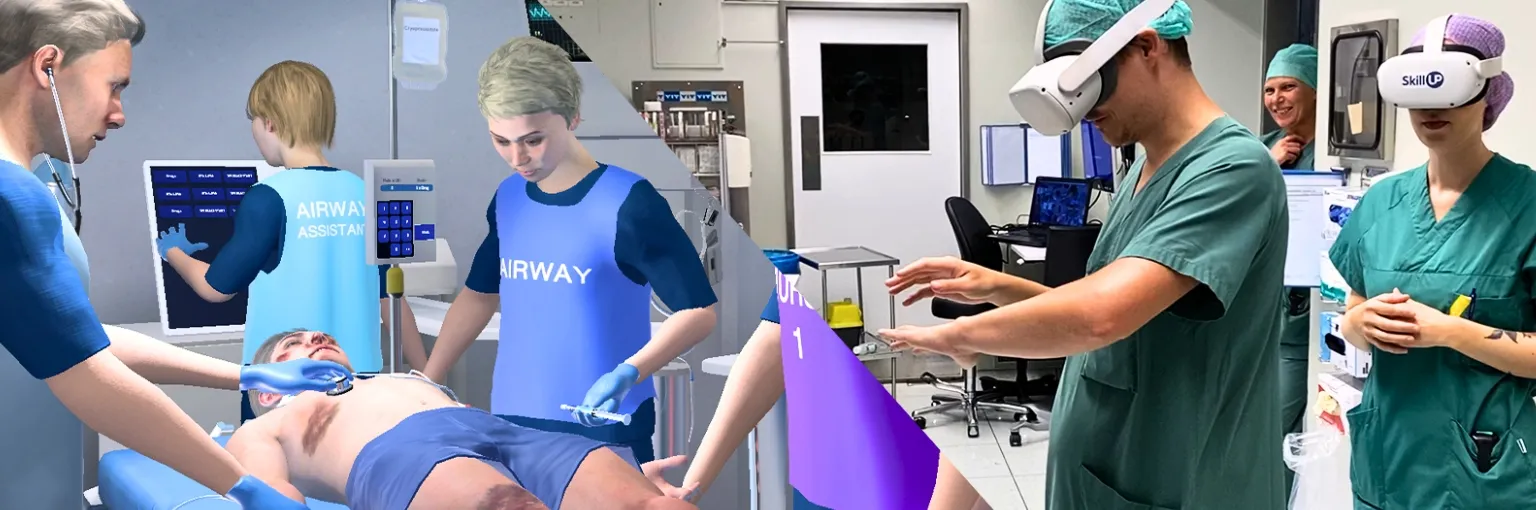
The Simlogic SkillupVR platform is designed to deliver immersive and scalable VR-based clinical training for healthcare education. Through realistic virtual simulations, learners can practise essential clinical procedures and decision-making skills in a safe, controlled environment while gaining hands-on experience without risk to patients.
To find out more about SkillupVR, visit our page now: https://bmec.asia/simlogic
More Information
- SkillupVR Product Page. https://skillupvr.com/product/
Simlogic, BMEC Pte Ltd